
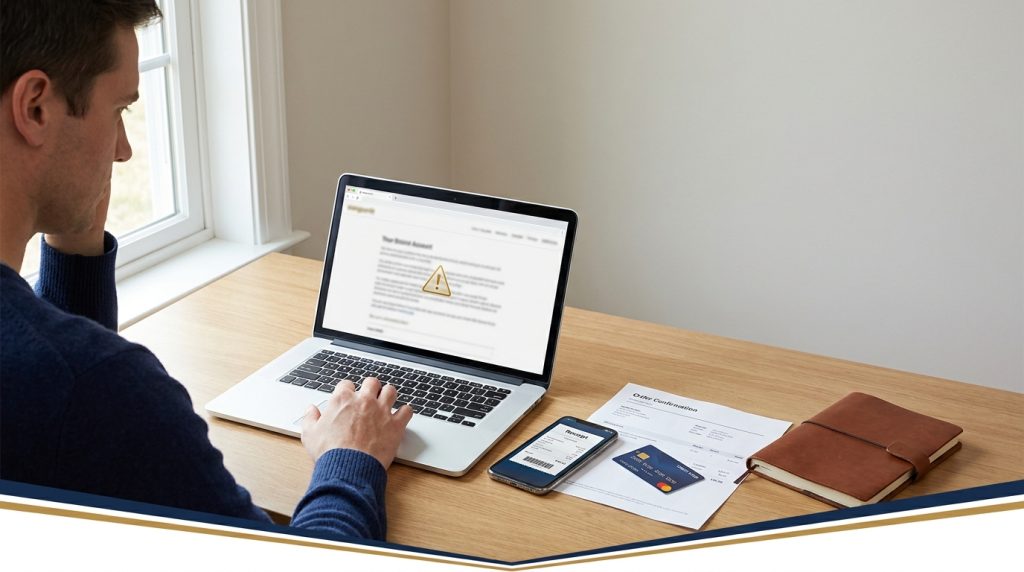
An online purchase scam checklist can become extremely useful when a seller takes your payment but never delivers what you ordered. The same applies when a product is completely different from what was advertised, a merchant disappears, or an unexpected charge appears on your account.
Online shopping makes purchases convenient, but it also gives dishonest sellers ways to look legitimate. A professional website, secure connection, polished advertisement, or social media presence does not prove that a merchant will deliver what it promises.
Recent Federal Trade Commission enforcement shows that payment fraud can involve more than the seller consumers see. In September 2026, the FTC announced action against payment processor Humboldt Merchant Services. The agency alleged that the company processed payments for more than 1,000 shell merchants that served as fronts or pass-through entities for fraudulent businesses.
If a purchase goes wrong, your strongest first step is usually documentation. Receipts, screenshots, emails, shipping promises, payment statements, and a clear timeline can help when contacting the merchant, marketplace, payment provider, regulator, or attorney.
This guide provides general educational information and is not legal advice.
Why Online Purchase Scams Require Good Records
When a transaction is normal, most people do not think about preserving evidence. They place an order, receive a confirmation email, and expect the package to arrive.
That changes quickly when the seller stops responding.
A consumer may remember seeing a specific shipping promise or refund policy. However, the website may later change. An advertisement can disappear. A social media account can be deleted. Messages may become difficult to find, and the merchant may use a different business name on a bank statement.
Saving information early reduces those problems.
Warning Signs That Deserve Extra Attention

Not every delayed order is a scam. Inventory problems, delivery delays, technical errors, and legitimate disputes can happen. Therefore, focus on facts instead of assuming fraud immediately.
Still, some warning signs justify closer attention. These include a seller offering expensive products at unusually low prices, refusing to provide clear contact information, repeatedly changing delivery dates, or insisting on unusual payment methods.
You should also be cautious when a seller pressures you to leave a trusted marketplace and send payment directly. Moving a transaction outside a marketplace’s payment system can mean losing protections the platform normally provides.
Before purchasing from an unfamiliar company, the FTC recommends searching the business name together with terms such as “complaint” or “scam.” It also advises consumers not to rely only on star ratings because reviews can be fake or misleading.
When the Seller or Website Suddenly Disappears
If a merchant’s website disappears after payment, preserve whatever remains immediately. Save your order confirmation, payment record, emails, text messages, advertisement screenshots, social media messages, and any shipping information.
Write down the exact website address and the business name shown during checkout. Then compare that information with the merchant name appearing on your credit card or bank statement.
Those names may not always match. However, recording both can help your payment provider understand which transaction you are disputing.
If you purchased through a marketplace, save the seller’s profile, listing, order number, and messages exchanged through the platform.
What Recent Payment Processor Cases Show Consumers
Payment processing normally happens behind the scenes. Consumers often see only the seller’s website and the final charge on their account.
However, recent FTC enforcement shows why the payment trail can matter. On September 8, 2026, the FTC announced a settlement involving Humboldt Merchant Services. According to the agency’s complaint, the processor handled payments for more than 1,000 merchants that allegedly operated as shell entities for fraudulent companies.
The proposed settlement requires a $12 million payment and would permanently restrict the company from processing payments for merchants presenting a heightened fraud risk.
The case does not mean a payment processor is responsible whenever a merchant dispute occurs. Rather, it illustrates why consumers should preserve the complete transaction record instead of documenting only the product advertisement.
You can read the FTC’s September 2026 Humboldt Merchant Services announcement for the agency’s allegations and settlement information.
The First Records You Should Save After an Online Purchase
Start your file as soon as you make an important online purchase. You do not have to wait for something to go wrong.
Save the merchant’s name and website address. Keep the product listing, description, photographs, advertised price, order confirmation, receipt, and expected delivery date.
Also preserve the seller’s refund, cancellation, and return policies that applied when you made the purchase.
The FTC specifically recommends keeping information about what you ordered, the date of the order, what you paid, the seller’s shipping promise, communications with the company, and account statements showing payment.
Our Legal Preparation Resources can help you organize these records into one folder rather than leaving important evidence scattered across email accounts, phones, and browser tabs.
If the issue involves broader consumer-rights questions, you can also review our Consumer Rights guides.
What to Do When an Online Seller Does Not Deliver
If the promised delivery date passes, check the tracking information first. Then contact the merchant using the contact method listed on its website or order confirmation.
Keep your message simple. Identify the order, explain what has not happened, and clearly state what resolution you are requesting.
For example, you may ask for proof of shipment, delivery by a specific reasonable date, cancellation, or a refund depending on the circumstances and applicable terms.
Avoid sending repeated emotional messages. A concise written communication creates a cleaner record.
Build a Dispute File Before You Escalate the Problem
Create a chronological timeline. Start with the advertisement or product listing, followed by the purchase date, payment, promised shipping date, subsequent communications, missed delivery dates, refund requests, and merchant responses.
Then place supporting evidence behind each event.
Your file might contain the original listing, checkout screenshot, receipt, payment statement, tracking page, emails, chat transcripts, and refund policy.
If the merchant changes its story, preserve each version. For example, save an email promising shipment on Friday and another message sent later claiming the item was already delivered.
You can use our Legal Checklists to create a more structured record before contacting outside organizations.
Contact the Seller, Marketplace, and Payment Provider

Try to resolve the issue with the seller when appropriate, but do not let a merchant’s delays cause you to miss important payment-dispute deadlines.
If you purchased through an online marketplace, review the marketplace’s buyer-protection process and deadlines. File a complaint through the platform when the seller does not resolve the problem.
If you paid by credit card, contact your card issuer quickly when merchandise was never delivered, a charge is incorrect, or another billing problem occurs. The FTC explains that credit cards generally provide stronger protections for online shopping than many other payment methods.
For certain credit card billing errors, federal procedures include time limits. The FTC advises consumers to contact the card issuer immediately and, when applicable, send the required written dispute so it reaches the issuer within 60 days after the first bill containing the error was mailed.
Debit cards, payment apps, bank transfers, cryptocurrency, gift cards, and other payment methods may involve different protections and procedures. Contact the relevant provider promptly instead of assuming the same rules apply.
Report the Scam and Know When to Seek Legal Help
If you believe the merchant engaged in fraud or deceptive business practices, consider reporting the matter to the FTC through ReportFraud.ftc.gov. The FTC uses consumer reports to identify patterns, investigate fraud, and warn other consumers.
You may also consider contacting your state attorney general or another appropriate consumer-protection agency.
When reporting the transaction, provide facts. Include the seller’s name, website, amount paid, date, payment method, promises made, attempts to obtain a refund, and supporting records.
If the loss is substantial, the situation involves many affected consumers, or the dispute raises complicated legal questions, speaking with a qualified attorney may also be appropriate. Visit our Find Legal Help page for trusted starting points for finding legal assistance.
The best time to preserve evidence is before you need it. Whenever you make a significant online purchase, save the product listing, receipt, payment confirmation, delivery promise, and applicable refund policy.
If the transaction later becomes a dispute, organize those records into a timeline and act promptly. Contact the seller, marketplace, and payment provider when appropriate, while paying close attention to applicable deadlines.
An online purchase scam can become confusing quickly. A well-organized record will not guarantee a refund, but it can make it much easier to explain what happened and support the steps you decide to take next.
The Legal Checklist provides general educational information only and does not provide legal advice. Consumer rights, payment protections, and dispute procedures vary depending on the transaction, payment method, jurisdiction, and circumstances.